photo credit: Brittney Cooper
Hiram Lane
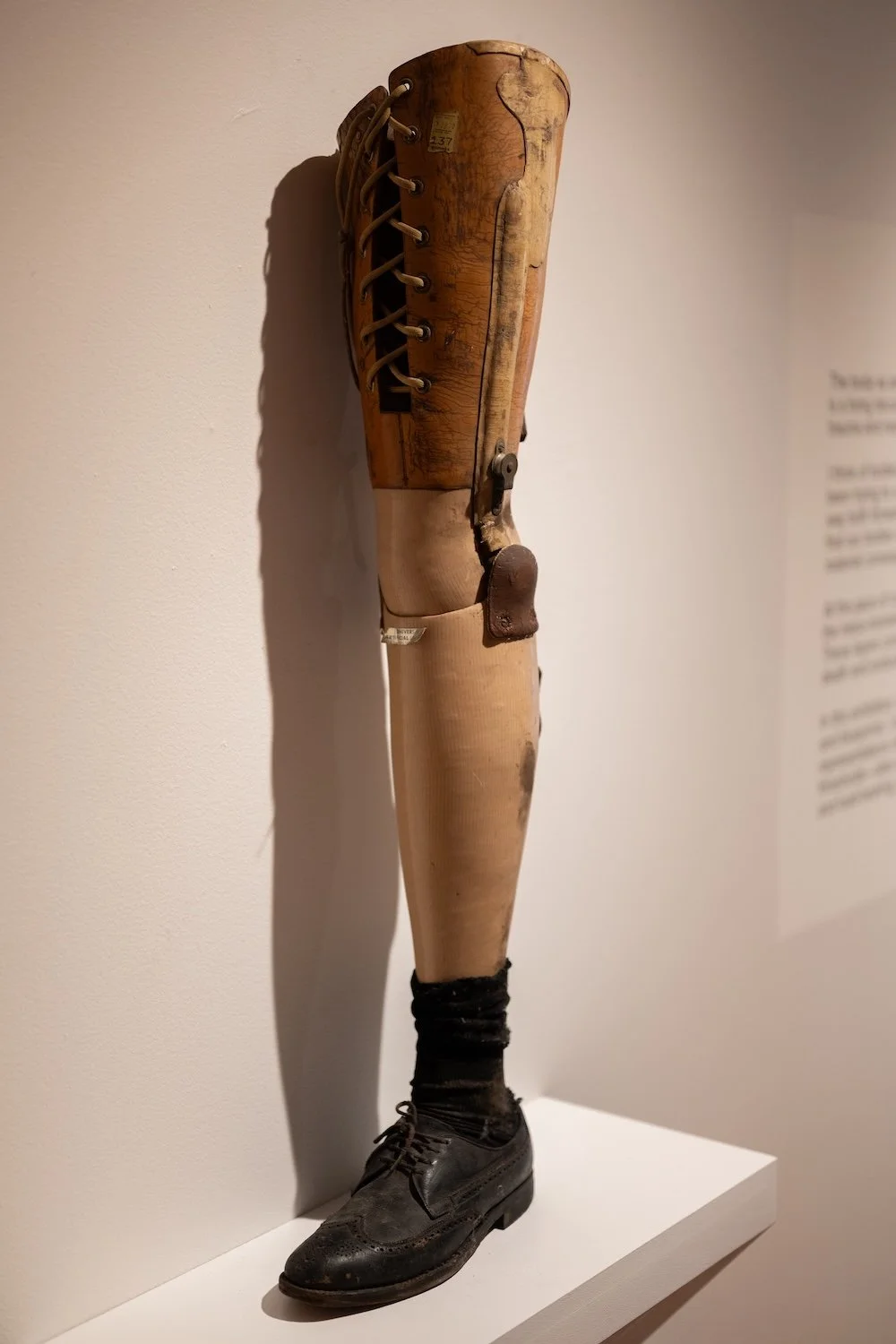
I never met my great-grandfather, Hiram Lane. He died before I was born, but I grew up surrounded by stories about him. The one repeated most often was how he survived gaseous gangrene during World War II. According to the matriarchal lore, he was the first person to survive the disease after losing both his legs—a survival attributed to being breast fed until the age of five.
For decades, the prosthetic leg was thought to be lost. Years later, after my great-grandparents' house had changed hands, it was discovered in the attic during a renovation. The construction crew placed it in the front window, where it was recognized by neighbors who knew my family. Eventually, it found its way back to us, still wearing its original sock and shoe.
Over time, the leg has become its own kind of midden: not simply a preserved prosthetic body part, but an accumulation of stories. Each retelling has deposited another layer—fact, embellishment, memory, affection, grief—until the object itself has become inseparable from the narratives that surround it. Like an archaeological shell mound, it preserves the traces of lives lived rather than a singular truth.
Whether every detail of the story is true no longer feels as important as the fact that it has endured. The leg has become more than a medical specimen or family relic; it is an artifact of inherited memory. Like the sculptures in this exhibition, it exists at the intersection of body, object, history, and myth.